Integrating Networks with Temperature Evolution#
So far, when integrating a reaction network in python, we’ve been solving
where \({\bf f}({\bf Y})\) is provided by the PythonNetwork rhs() function that is generated by write_network.
Now we want to instead solve the system:
where \(\epsilon\) is the specific energy generation rate from the network and \(c_x\) is a specific heat (usually volume or pressure, depending on the application).
Note
The rhs and jacobian functions produced by write_network do not include temperature evolution, so we will need to wrap the rhs function and have the integrator approximate the Jacobian via differencing.
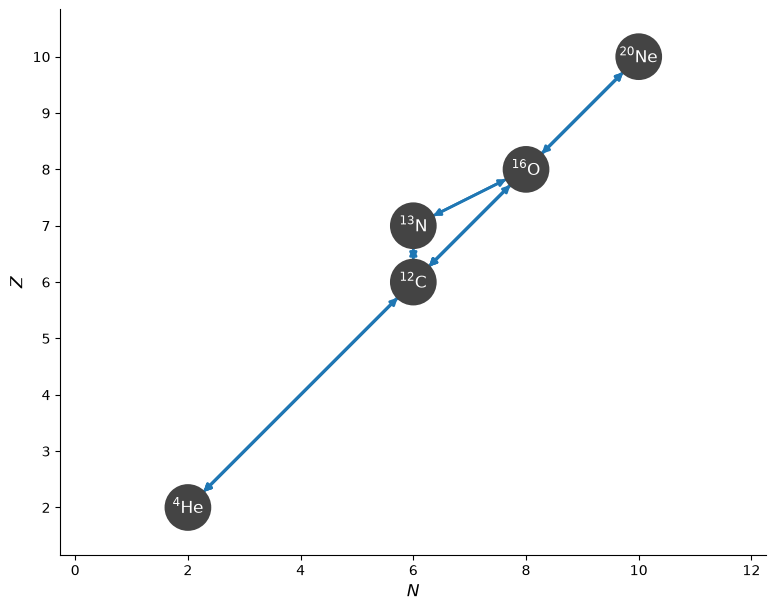
Let’s start with a simple He-burning network.
import pynucastro as pyna
net = pyna.network_helper(["p", "he4", "c12", "n13", "o16", "ne20"])
fig = net.plot()
No temperature evolution#
First we’ll integrate without evolving the temperature.
rho = 1.e5
T = 2.e8

comp = pyna.Composition(net.unique_nuclei)
comp.X[pyna.Nucleus("he4")] = 1
comp.normalize()
Y0 = comp.get_molar_array()
tmax = 1.e7
sol = net.integrate_network(tmax, rho, T, Y0, rtol=1.e-6, atol=1.e-6)
/opt/hostedtoolcache/Python/3.14.6/x64/lib/python3.14/site-packages/pynucastro/rates/derived_rate.py:125: UserWarning: C12 partition function is not supported by tables: set log_pf = 0.0 by default
  warnings.warn(UserWarning(f'{nuc} partition function is not supported by tables: set log_pf = 0.0 by default'))
/opt/hostedtoolcache/Python/3.14.6/x64/lib/python3.14/site-packages/pynucastro/rates/derived_rate.py:125: UserWarning: N13 partition function is not supported by tables: set log_pf = 0.0 by default
  warnings.warn(UserWarning(f'{nuc} partition function is not supported by tables: set log_pf = 0.0 by default'))
fig = sol.plot_evolution(ymin=1.e-6)
/opt/hostedtoolcache/Python/3.14.6/x64/lib/python3.14/site-packages/pynucastro/networks/python_network.py:467: UserWarning: Attempt to set non-positive xlim on a log-scaled axis will be ignored.
  ax.set_xlim(tmin, tmax)
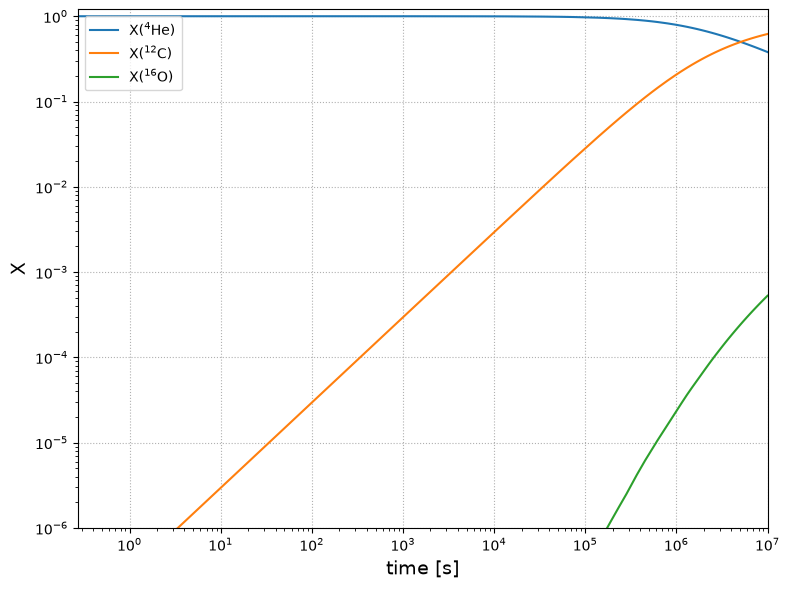
We see it takes about \(10^6\) s for the He mass fraction to start to deplete significantly.
Evolving temperature#
When we evolve temperature, we wrap the network’s righthand side function that works on molar fractions, \(Y\), with one that includes temperature. We’ll call our vector of unknowns \(\xi = ({\bf Y}, T)\).
This wrapper that computes \(d\xi/dt\), calling the EOS each evaluation of the righthand side function to get the updated specific heat.
We enable this integration mode by passing self_heating=True to integrate_network.
Note
Currently, temperature support is not present in the Jacobian, so integration with
self_heating=True will use a numerical Jacobian. Additionally, the wrapper function
is not Numba-compiled. As a result, integrating with temperature evolution can be slow.
sol2 = net.integrate_network(tmax, rho, T, Y0, self_heating=True,
                             rtol=1.e-6, atol=1.e-6)
/opt/hostedtoolcache/Python/3.14.6/x64/lib/python3.14/site-packages/pynucastro/rates/derived_rate.py:125: UserWarning: C12 partition function is not supported by tables: set log_pf = 0.0 by default
  warnings.warn(UserWarning(f'{nuc} partition function is not supported by tables: set log_pf = 0.0 by default'))
/opt/hostedtoolcache/Python/3.14.6/x64/lib/python3.14/site-packages/pynucastro/rates/derived_rate.py:125: UserWarning: N13 partition function is not supported by tables: set log_pf = 0.0 by default
  warnings.warn(UserWarning(f'{nuc} partition function is not supported by tables: set log_pf = 0.0 by default'))
Now we can visualize. First the composition.
fig = sol2.plot_evolution(ymin=1.e-6)
/opt/hostedtoolcache/Python/3.14.6/x64/lib/python3.14/site-packages/pynucastro/networks/python_network.py:467: UserWarning: Attempt to set non-positive xlim on a log-scaled axis will be ignored.
  ax.set_xlim(tmin, tmax)
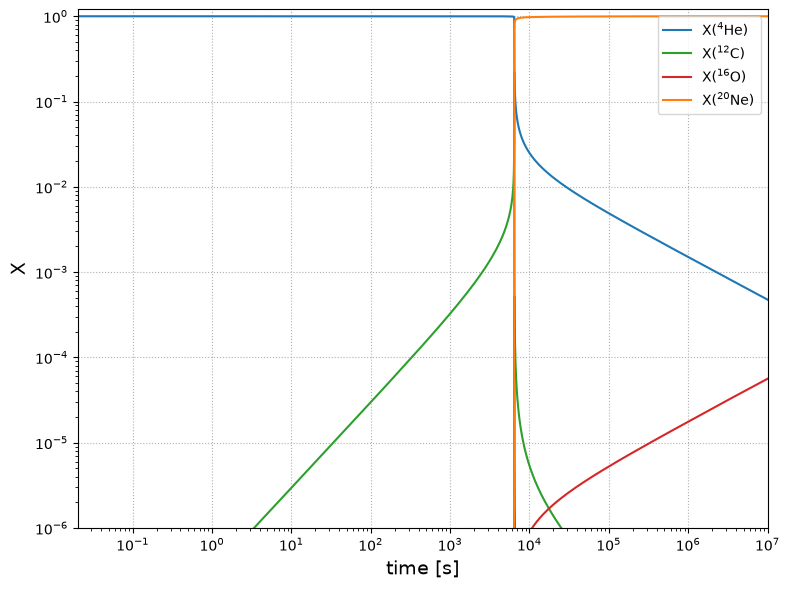
This looks dramatically different than the fixed-temperature case. This is not too surprising, since at these temperatures, the 3-\(\alpha\) rate is very temperature sensitive, so as the temperature increases due to the energy release from burning, the He burning rate increases dramatically.
fig = sol2.plot_temperature()
/opt/hostedtoolcache/Python/3.14.6/x64/lib/python3.14/site-packages/pynucastro/networks/python_network.py:527: UserWarning: Attempt to set non-positive xlim on a log-scaled axis will be ignored.
  ax.set_xlim(tmin, tmax)
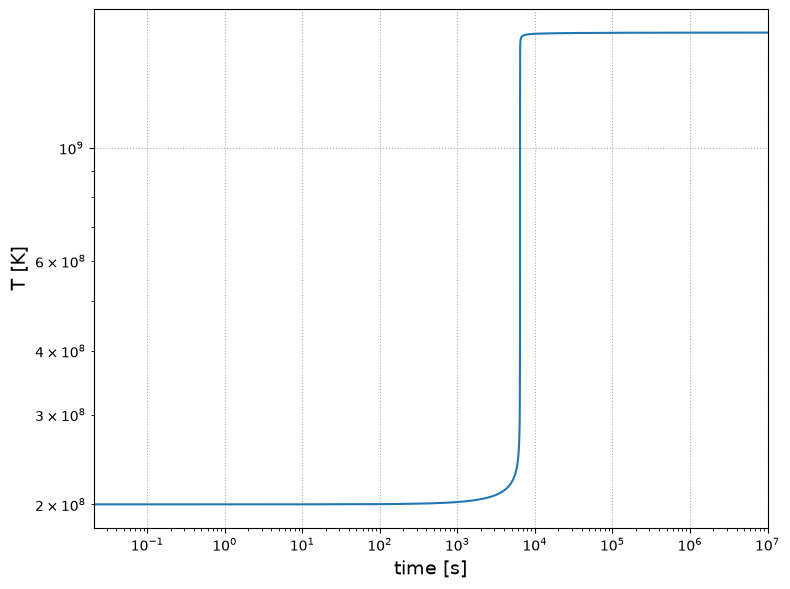
We see that the temperature increased from \(2\times 10^8\) K to over \(1.6\times 10^9\) K.
Caution
In a real star, this energy release would drive a hydrodynamic flow which, depending on the timescale of the energy release vs. sound waves, could drive an expansive flow and quench some of this heating. To really capture this, a full hydrodynamics calculation is needed.
Tip
It is straightforward to include thermal neutrino loses in the temperature evolution equation as well,
using the sneut5 method.