Finding the Likely Path Between Nuclei (with NetworkX)#
We can also use NetworkX to find the most probable path between two nuclei in the network.
Consider the reaction \(X(a,b)Z\). This will compete with all of the other reactions that consume nucleus \(X\), so we can compute the probability (or branching ratio) of \(X(a,b)Z\) being taken as:
where \(\dot{Y}\) is the full expression for the rates contribution to the \(dY/dt\) evolution (i.e., includes density and molar fraction terms).
Now, if we want to compute the probability of taking a path from nucleus \(A\) to \(B\) in a network, we would compute
and if we want to find the most likely path, then we want to find the path that has the maximum \(P_\mathrm{path}\).
Note
In our \(p_{X(a,b)Z}\), the molar fraction of the reactant, \(Y(X)\), cancels out. This is what we want, since a path may be probably even if the abundance of the reactant is small because it is not a waiting-point, i.e., there is a lot of flow through that nucleus.
In NetworkX, the graph algorithms can minimize the distance through a network, so we need to express our \(P_\mathrm{path}\) in a way that is compatible with this. We observe that:
Since NetworkX will find the minimum distance, if we set the edge weights in our network to be
then we can find the most probably path by asking NetworkX to find the shortest path.
The method create_network_graph can assign
this weighting to the exported NetworkX graph by setting use_branching_ratios = True.
import pynucastro as pyna
import networkx as nx
A CNO example#
We’ll start with a CNO + breaking network
nuclei = ["p", "he4",
          "c12-13", "n13-15", "o14-18",
          "f17-19", "ne18-20"]
net = pyna.network_helper(nuclei, tabular_ordering=["ffn", "oda"])
Let’s pick a thermodynamic state this is hot enough to expect breakout from hot-CNO
rho = 1.e4
T = 5.e8
comp = pyna.Composition(net.unique_nuclei, init="solar")
state = pyna.ThermoState(rho=rho, T=T, comp=comp)
Now we evaluate the rates (using evaluate_rates—this gives us a dict of the \(\dot{Y}\) terms:
rates = net.evaluate_rates(state)
/opt/hostedtoolcache/Python/3.14.8/x64/lib/python3.14/site-packages/pynucastro/rates/derived_rate.py:129: UserWarning: C12 partition function is not supported by tables: set log_pf = 0.0 by default
  warnings.warn(UserWarning(f'{nuc} partition function is not supported by tables: set log_pf = 0.0 by default'))
/opt/hostedtoolcache/Python/3.14.8/x64/lib/python3.14/site-packages/pynucastro/rates/derived_rate.py:129: UserWarning: N13 partition function is not supported by tables: set log_pf = 0.0 by default
  warnings.warn(UserWarning(f'{nuc} partition function is not supported by tables: set log_pf = 0.0 by default'))
/opt/hostedtoolcache/Python/3.14.8/x64/lib/python3.14/site-packages/pynucastro/rates/derived_rate.py:129: UserWarning: C13 partition function is not supported by tables: set log_pf = 0.0 by default
  warnings.warn(UserWarning(f'{nuc} partition function is not supported by tables: set log_pf = 0.0 by default'))
/opt/hostedtoolcache/Python/3.14.8/x64/lib/python3.14/site-packages/pynucastro/rates/derived_rate.py:129: UserWarning: N14 partition function is not supported by tables: set log_pf = 0.0 by default
  warnings.warn(UserWarning(f'{nuc} partition function is not supported by tables: set log_pf = 0.0 by default'))
/opt/hostedtoolcache/Python/3.14.8/x64/lib/python3.14/site-packages/pynucastro/rates/derived_rate.py:129: UserWarning: N15 partition function is not supported by tables: set log_pf = 0.0 by default
  warnings.warn(UserWarning(f'{nuc} partition function is not supported by tables: set log_pf = 0.0 by default'))
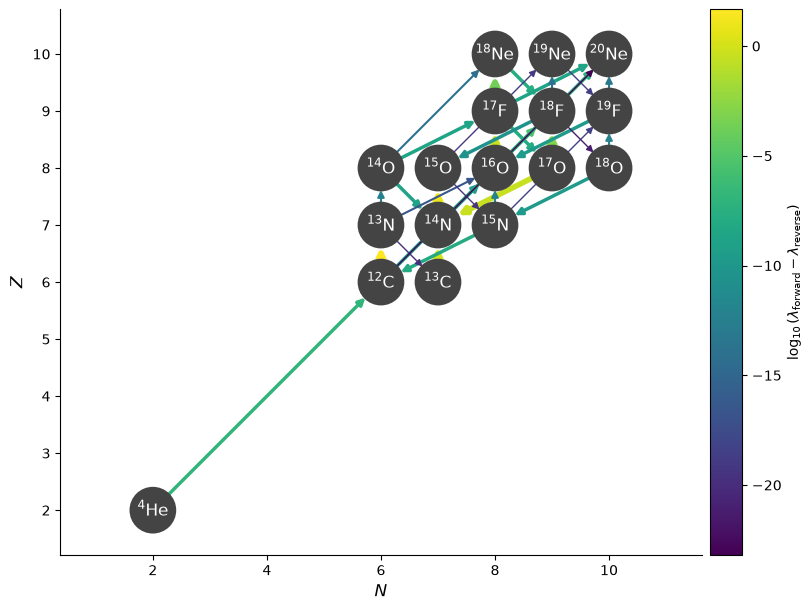
Here’s a visual representation of the network at this state
fig = net.plot(rho=rho, T=T, comp=comp, use_net_rate=True)
/opt/hostedtoolcache/Python/3.14.8/x64/lib/python3.14/site-packages/pynucastro/rates/derived_rate.py:129: UserWarning: C12 partition function is not supported by tables: set log_pf = 0.0 by default
  warnings.warn(UserWarning(f'{nuc} partition function is not supported by tables: set log_pf = 0.0 by default'))
/opt/hostedtoolcache/Python/3.14.8/x64/lib/python3.14/site-packages/pynucastro/rates/derived_rate.py:129: UserWarning: N13 partition function is not supported by tables: set log_pf = 0.0 by default
  warnings.warn(UserWarning(f'{nuc} partition function is not supported by tables: set log_pf = 0.0 by default'))
/opt/hostedtoolcache/Python/3.14.8/x64/lib/python3.14/site-packages/pynucastro/rates/derived_rate.py:129: UserWarning: C13 partition function is not supported by tables: set log_pf = 0.0 by default
  warnings.warn(UserWarning(f'{nuc} partition function is not supported by tables: set log_pf = 0.0 by default'))
/opt/hostedtoolcache/Python/3.14.8/x64/lib/python3.14/site-packages/pynucastro/rates/derived_rate.py:129: UserWarning: N14 partition function is not supported by tables: set log_pf = 0.0 by default
  warnings.warn(UserWarning(f'{nuc} partition function is not supported by tables: set log_pf = 0.0 by default'))
/opt/hostedtoolcache/Python/3.14.8/x64/lib/python3.14/site-packages/pynucastro/rates/derived_rate.py:129: UserWarning: N15 partition function is not supported by tables: set log_pf = 0.0 by default
  warnings.warn(UserWarning(f'{nuc} partition function is not supported by tables: set log_pf = 0.0 by default'))
Now we can create the network graph.
Important
Note that by default, we don’t include edges connecting \({}^4\mathrm{He}\) to its products directly (this is controlled by hide_xalpha=True). This is the behavior we want—we only want to consider the edges connecting the heavy nuclei, since \(\alpha\) are involved in a lot of reactions. Put another way, we only want each reaction to map to a single edge in the network, not multiple edges connecting different nuclei.
G = net.create_network_graph(net.unique_nuclei,
                             rate_ydots=rates, use_branching_ratios=True)
Finally, we can use the NetworkX shortest_path function. Let’s find the path between \({}^{12}\mathrm{C}\) and \({}^{18}\mathrm{F}\)
weighted_path = nx.shortest_path(G,
                                 source=pyna.Nucleus("c12"),
                                 target=pyna.Nucleus("f18"),
                                 weight="weight")
we see the most probably path is:
weighted_path
[C12, N13, O14, F17, Ne18, F18]
Looking at the figure showing the rates, we see that the two rates leaving \({}^{14}\mathrm{O}\) are very close in magnitude. We can see the branching probabilities from the graph:
import numpy as np
for u, v, data in G.edges(data=True):
    if u == pyna.Nucleus("o14"):
        print(f"{u!s:4}-> {v!s:4}: p = {np.exp(-data["weight"]):8.3g}")
O14 -> N14 : p =    0.413
O14 -> Ne18: p = 2.95e-06
O14 -> F17 : p =    0.587
O14 -> N13 : p = 1.04e-34
We see that the path to \({}^{14}\mathrm{N}\) is almost as likely as the path to \({}^{17}\mathrm{F}\)